
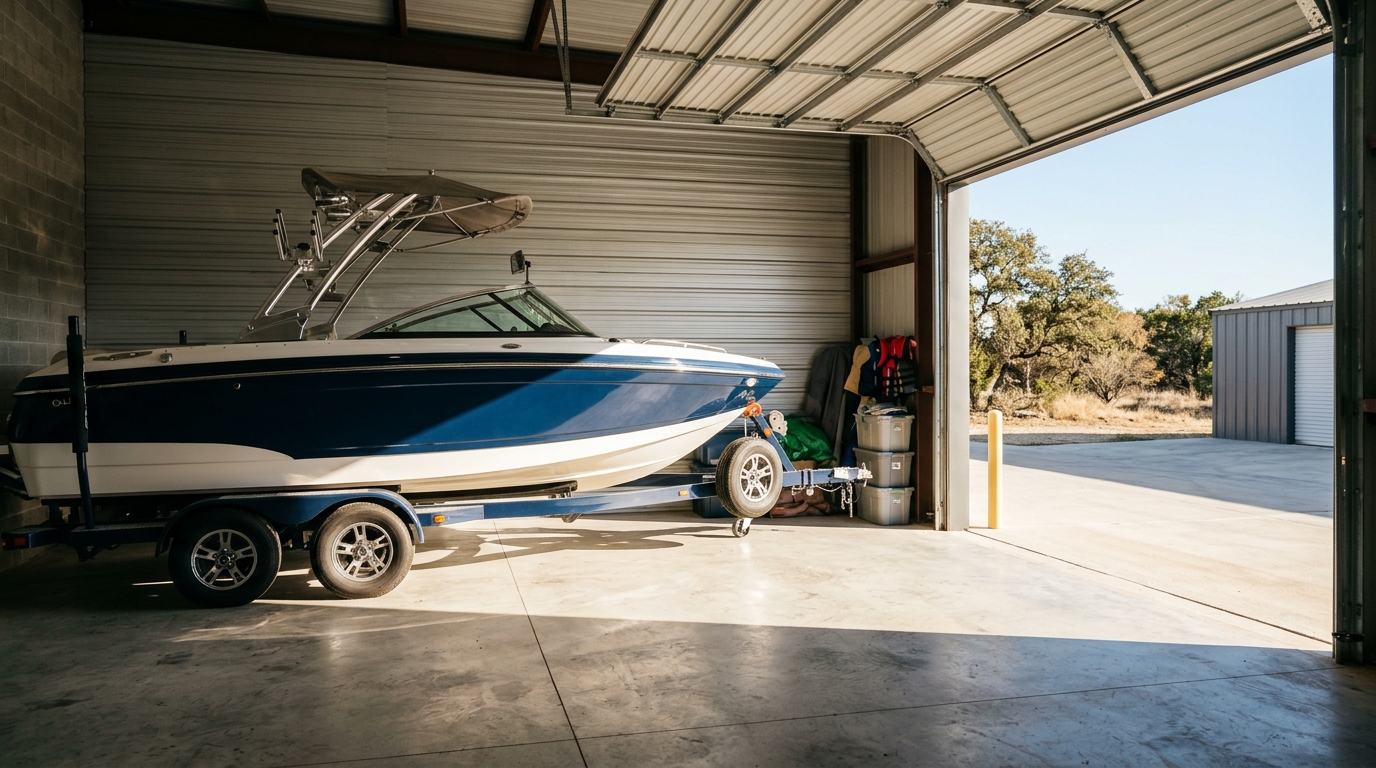
If you leave water sitting in your boat's cooling lines over a cool Texas winter, you might be looking at a cracked engine block and a four-digit repair bill come March. Anyone who spends their weekends pulling wakeboarders across Canyon Lake or cruising down the Guadalupe knows how much wear a long summer puts on a craft. When water season winds down, parking your vessel in your driveway seems easy enough—until your HOA sends a warning letter or your driveway turns into a sun-baked parking spot that fades your upholstery. Securing reliable boat storage New Braunfels owners rely on keeps your investment safe from hail, sun rot, and unexpected freeze damage while keeping your driveway clear.
Preparing a boat for several months of sitting takes a little elbow grease, but doing it right ensures that the engine turns over on the very first turn of the key next spring. Here is your step-by-step checklist to get your boat off-season ready.
1. Drain every drop of water from the engine and hull
Water is your boat's biggest enemy when it sits idle. Even in our mild Central Texas climate, overnight temperature dips below freezing can expand trapped water inside engine passages, cracking manifolds and pumps. Start by lowering the outdrive or outboard engine completely down so gravity can pull trapped water out.
Open all engine drain plugs, manifold drains, and sea cocks according to your owner's manual. If your boat has ballast tanks for wakeboarding, pump them entirely dry and run a non-toxic marine antifreeze through the ballast pumps. Don't forget live wells, raw-water washdown hoses, and onboard fresh-water sinks. Finally, pull the main hull drain plug at the transom, elevate the trailer tongue high into the air, and let any water sitting in the bilge drain completely out before parking your rig.
2. Stabilize your fuel and change the engine oil
Gasoline containing ethanol starts breaking down in as little as 30 days. As it degrades, it leaves behind gummy varnish deposits that clog fuel injectors, float bowls, and small fuel passages. Before your last run on the water, stop by a marina or auto store for a quality marine fuel stabilizer. Add it directly to your tank, then run the engine for 10 to 15 minutes to pull the treated fuel through the fuel lines, filters, and injectors.
Once you run the engine with stabilized fuel, change the engine oil and oil filter. Running an engine all summer creates acidic byproducts, moisture, and fine metallic debris in the oil. If left sitting in the crankcase all winter, those contaminants pit internal engine bearings and cause internal corrosion. Fresh oil protects precision metal surfaces while the engine sits dormant.
3. Scrub the hull and clean out the interior completely
Algae, lake scum, and water spots become nearly impossible to remove if you let them sit and bake on your hull for three months. Wash the exterior thoroughly with marine soap immediately after pulling your boat out of the water. Applying a fresh coat of wax to the fiberglass gelcoat adds an extra barrier against dust and moisture oxidation while stored.
Moving to the interior, pull out every single item: life jackets, tow ropes, towels, fishing tackle, and trash. If you leave even a stray granola bar wrapper or wet towel behind, you invite rodents and mildew inside. Vacuum the carpets, wipe down vinyl seats with a UV-protectant vinyl cleaner, and leave all seat cushions propped upright. Keep compartment doors slightly open to allow air circulation, preventing musty odors from forming during humid weather snaps.
4. Pull the battery and store delicate gear separately
Leaving a marine battery connected while a boat is parked will slowly drain it down to zero, destroying its ability to take a full charge again. Disconnect the negative terminal first, unstrap the battery, and take it home. Store it off the ground in a garage or workshop, and hook it up to a smart trickle charger once a month to preserve its lifespan.
This is also the time to remove high-value accessories. Unclip your fish finders, GPS units, marine radios, and detachable stereo faceplates. Extreme heat inside closed spaces can ruin delicate LCD screens. If you have high-value wakeboards, specialized fishing gear, or custom leather cushions that need extra protection from Texas humidity swings, consider putting those smaller items in a climate-controlled storage unit while your boat rests.
5. Pick the right cover and unit size for your setup
A fitted, breathable marine cover is essential for keeping dust, bird droppings, and leaves off your boat. Avoid cheap blue plastic tarps—they trap moisture underneath, creating a greenhouse effect that spawns mold and ruins vinyl graphics.
Before choosing a space, measure your boat's total footprint from the tip of the trailer hitch to the back of the engine prop, as well as the overall width and tower height. A typical 20-foot bowrider on a single-axle trailer often requires 24 to 26 feet of total bumper-to-hitch clearance. For most ski boats, pontoon craft, or bass boats, our 12x30 Drive-Up unit ($199.00/mo) offers ample room to park the trailer, swing open storage lockers, and store extra water gear alongside the craft.
Taking an afternoon to run through this checklist guarantees your boat will be ready to drop into the water the moment warm weather hits New Braunfels again. At StoreMore Warehouses LLC, our family has been helping local water lovers protect their boats and gear off Schumanns Beach Rd since 2004. If you need clean, secure storage units for your boat or seasonal equipment, call us at (830) 626-6800 or stop by the office to check out available spaces.